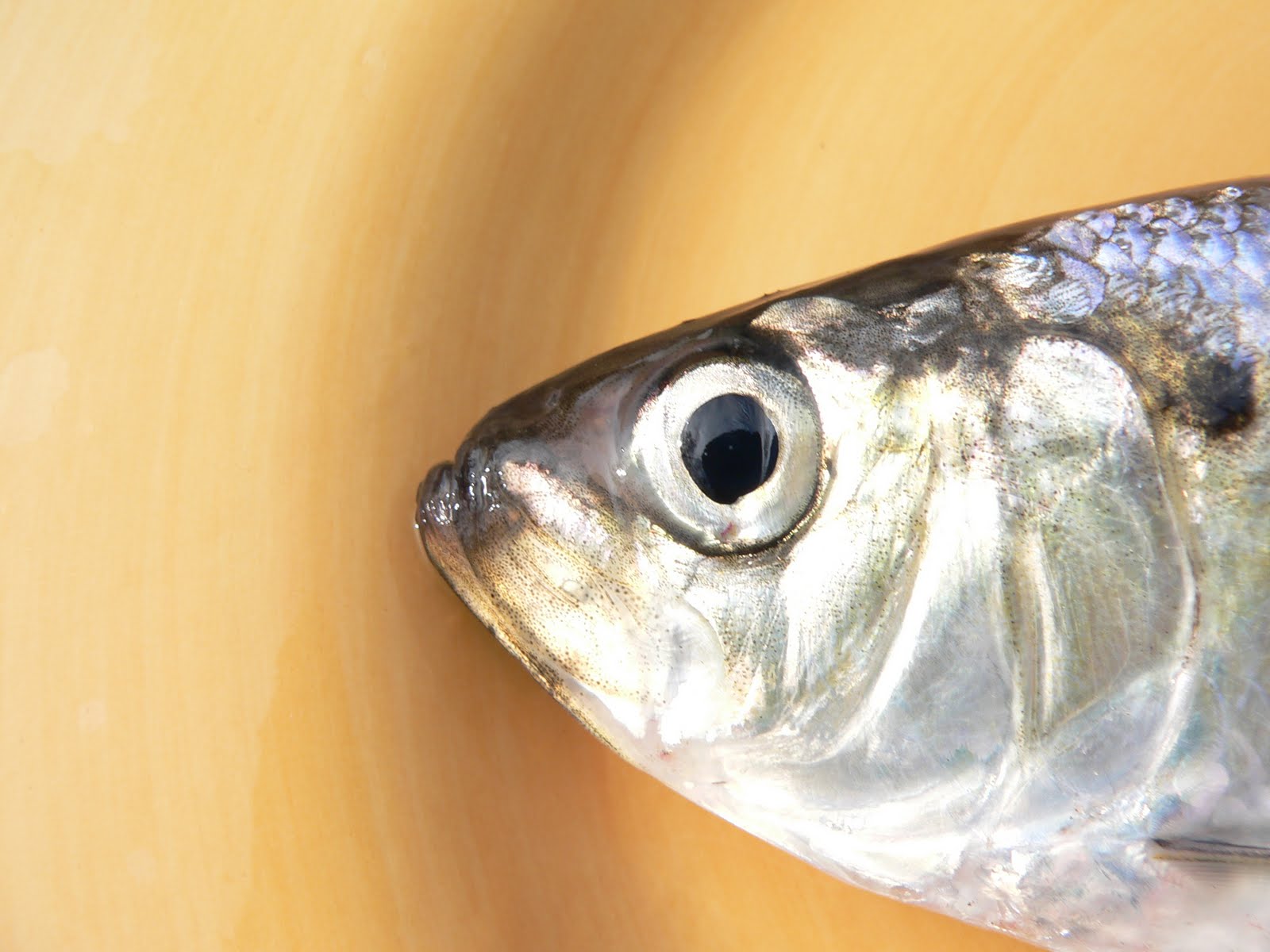
We have heard a ton of good things about American Eel. We were excited to eat it.
After photographing this eel, we quickly killed it and skinned it. Skinning eels is really easy, simply cut the fish around the the head and hold it by the mouth with a pair of pliers. Some people nail them to trees, but we decided that was a bit much.
Once the eel has been cut all the way around grab the skin with another pair of pliers and pull hard. The skin will come off like an old sock. Some people make leather out of the eels skin, feel free to to that and let us know how it goes!
After bringing the eel back to Dave's house we chopped it into manageable pieces rolled it in flour and seasoning and fried it in hot oil. This is what was recommended by pretty near everyone we talked to and the eel smelt yummy. People also warned us that the eel would squirm in the pan, and to our dismay that didn't happen.
After the fish was thoroughly cooked we dove in. Clay got the tail and Dave chose a more interior piece.
As our title indicated we were really disappointed, The eel was tough and flavorless, what a shame, this may be a fish we need a re-do on, maybe a real eel chef could cook one up for us sometime.
Sunday, June 12, 2011
Friday, June 10, 2011
Catadromous is the word of the day with fish number 19 American Eel!
We headed to the Exeter River to fish for American Eel behind Phillips Exeter Academy. We felt a little out of place at this boarding school, but we wanted to fish this spot because the authors of "Fishing for Buffalo" mentioned this as the only spot they've ever caught American eel.
American Eel are the only catadromous fish we can name, that means they are born in the ocean and migrate to freshwater for most of their lives and then return to the ocean to spawn. The really cool thing about eels is the female eels will migrate for hundreds of miles inland crossing roads and dry land to get to their hang outs.
Eel fishing is super easy, use a pretty heavy slip sinker, a small hook and a big fat worm. Throw that in the river at dusk and wait.
Dave attached a bell to his fishing pole to let him know when the fish was on.
While we were waiting for the eel we caught a bluegill, a brown bullhead and a pumpkinseed.
We fished for under an hour and the eel came easily. This fish was probably the slimiest thing we've dealt with so far. When the slime dried on our skin it could be peeled off like Elmer's glue. Check back for our Eel cooking experience!
American Eel are the only catadromous fish we can name, that means they are born in the ocean and migrate to freshwater for most of their lives and then return to the ocean to spawn. The really cool thing about eels is the female eels will migrate for hundreds of miles inland crossing roads and dry land to get to their hang outs.
Eel fishing is super easy, use a pretty heavy slip sinker, a small hook and a big fat worm. Throw that in the river at dusk and wait.
Dave attached a bell to his fishing pole to let him know when the fish was on.
While we were waiting for the eel we caught a bluegill, a brown bullhead and a pumpkinseed.
We fished for under an hour and the eel came easily. This fish was probably the slimiest thing we've dealt with so far. When the slime dried on our skin it could be peeled off like Elmer's glue. Check back for our Eel cooking experience!
Monday, June 6, 2011
What's that your listening to? Listen closely and Dance with fish #18 Rock Bass!
After failing to score our target fish on the Connecticut River we decided to cut our losses and go for something easy.
Rock Bass, fish number 18! We chose to catch these off the docks in center harbor, the technique is really simple.
Bounce a jig tipped with worm along the rocks, and constantly set the hook. Eventually there will be a fish on, we were fortunate that we were able to sight fish for these bass. We could barely feel the strike, but once they were on we had a good fight on our hands.
Sunday, June 5, 2011
A Kibbie By Any Other Name
NH anglers typically call any of the small sunfish a "kibbie", but we think they are most often referring to a pumpkinseed (quest fish number 14). We have only logged three sunfish species for the quest so far: black crappie, bluegill, and pumpkinseed. Here are their pictures:
The crappie is clearly different, but the other two appear similar. The thing to look at is the "ear" or the little flap on the gill cover. On a bluegill, this ear is completely black. On the pumpkinseed, it has a red dot.
There are three other sunfish on our quest that will look similar, but their ears are different.
redbreast sunfish = very long black ear with light margin at the base
rock bass = small black dot completed surrounded by light margin, red eye
banded sunfish = no ear, rounded tail
We hope this ID info helps the next time you are out fishing. Good Luck!
| pumpkinseed |
| bluegill |
The crappie is clearly different, but the other two appear similar. The thing to look at is the "ear" or the little flap on the gill cover. On a bluegill, this ear is completely black. On the pumpkinseed, it has a red dot.
There are three other sunfish on our quest that will look similar, but their ears are different.
redbreast sunfish = very long black ear with light margin at the base
rock bass = small black dot completed surrounded by light margin, red eye
banded sunfish = no ear, rounded tail
We hope this ID info helps the next time you are out fishing. Good Luck!
Saturday, June 4, 2011
Fish #17 Common Shiner
We found a school of these fish in beautiful spawning colors parked behind a riffle with large cobblestone bottom. They were in about two feet of water. We used a small icefishing jig tipped with a red worm. As soon as the lure hit the water, they were on it.
Dave ate a common shiner when he was in Indiana and remembered that it did not taste very good. He also is a bad fish chef. We froze these for later preparation. We are thinking about smoking them.
These fish were really nice looking and reminded us of fancy aquarium fish you would by in a pet store.
ASIDE:
We actually targeted the Lamprey River for common shiners. We found a study online that reported the relative abundance of fish species at several different stations. This information was made available because the Lamprey River is part of the NH Designated Rivers Program and thus gets extra protection of encroachment by development. In our opinion, every angler and lover of wild river things should applaud the work of NHDES and volunteer groups like the Lamprey River Watershed Association or the Lamprey River Advisory Committee. We don't volunteer our time, but we appreciate their work.
Thursday, June 2, 2011
Fish #16 Redfin Pickerel
Fish number 16 of the quest was quite special. This little fish is a tiny predator of swampy water that is acidic and stained with tannins from rotting vegetation. Areas like this on the Taylor River is what we are talking about.
In the current, just ahead of a culvert. We floated a small ice fishing jig tipped with a red worm. We could not see any fish, but we figured that would be the spot a fish would be. On the second cast we had a strike and pulled in this beauty - a Redfin Pickerel, Esox americanus americanus
It is in the same family as the pickerel and pike, but this little delicate jewel hangs out in small water where the other two dare not swim.
NH Fish and Game considers these fish a "Species of Concern" because there are not that many records of them and they live in water that can be severly impacted from development. Taking one of these fish will not hurt the population and we feel very lucky to have seen one.
Wednesday, June 1, 2011
Wasted time on the Connecticut River....
We headed to Hanover to fish for walleye today, had no luck as the water was too turbulent and we didn't really know what we were doing... Oh well you can't win them all!
Monday, May 30, 2011
Happy Memorial Day! Fish Quiz
Happy Memorial Day!
Here is a little preview of our next fish. Do you know what it is?
Full report in a few days.
Here is a little preview of our next fish. Do you know what it is?
Full report in a few days.
Sunday, May 29, 2011
Fish # 15 Brown Trout
We are happy to add a "Field and Stream" fish to the quest: the Brown Trout (Salmo trutta). We call it a "Field and Stream" fish because it is one of those species that the magazine would published a story about and use descriptive words like "legendary" and "trophy". It is a major game fish.
Our charasmatic brownie came from the Lamprey River in Raymond, NH.
This fish was fooled by a small lead-free jig tipped with a redworm. The retrieve that seemed to drive the fish crazy was a slow, jerky one - causing the worm to look like a swimming leech or perhaps an eel. Regardless, It looked like dinner to this trout.
We kept the first one, but kept casting because it was just down right fun. We caught a twin to this fish, a rainbow trout about the same size, and many, many fallfish.
The brown trout is not native to New Hampshire and is stocked regularly by NH Fish and Game Department. According to their website, "In New Hampshire, brown trout are usually between 7 and 14 inches and weigh less than one pound. However, it is not uncommon to find fish that weigh between 2 and 4 pounds. After reaching about 12 inches, they feed almost solely on baitfish during twilight and nighttime hours. Live bait, spinners and flies fished at dusk are equally effective on brown trout."
Our charasmatic brownie came from the Lamprey River in Raymond, NH.
This fish was fooled by a small lead-free jig tipped with a redworm. The retrieve that seemed to drive the fish crazy was a slow, jerky one - causing the worm to look like a swimming leech or perhaps an eel. Regardless, It looked like dinner to this trout.
We kept the first one, but kept casting because it was just down right fun. We caught a twin to this fish, a rainbow trout about the same size, and many, many fallfish.
The brown trout is not native to New Hampshire and is stocked regularly by NH Fish and Game Department. According to their website, "In New Hampshire, brown trout are usually between 7 and 14 inches and weigh less than one pound. However, it is not uncommon to find fish that weigh between 2 and 4 pounds. After reaching about 12 inches, they feed almost solely on baitfish during twilight and nighttime hours. Live bait, spinners and flies fished at dusk are equally effective on brown trout."
Saturday, May 28, 2011
Bonus Fish: River Herring
We can not count this in the quest because it was caught with a net, but we thought our fans would like to see the pictures. A few weeks ago we ran into our old fishing friend Jim, whom we only see during the herring run. He was out doing a little catch and release herring netting.
Jim is the best citizen advocate we know for the herring and for the fishermen who catch them for lobster and striper bait. He is convinced that there is enough herring spawning beneath the Exeter River fish ladder to sustain more harvest than NH Fish and Game currently allows. Right now people can only net on Saturdays and Mondays. No one can touch them on Wednesdays. This restriction is based on the number of herring that go up the ladder, which is a pitiful in most years. But there are thousands below the ladder that never make it up.
Jim caught a bunch in his net and all but one go. He gave us one for the quest. We took it home and cleaned it in preparation for smoking later.
We don't claim to be able to tell the difference between alewife (Alosa pseudoharengus) and bluebacked herring (Alosa aestivalis) - both are called river herring. If we had to guess we would say this was an alewife. They are suppose to be the dominate fish in that river and the internal body cavity of a bluebacked has a black lining. We did not see that.
Jim is the best citizen advocate we know for the herring and for the fishermen who catch them for lobster and striper bait. He is convinced that there is enough herring spawning beneath the Exeter River fish ladder to sustain more harvest than NH Fish and Game currently allows. Right now people can only net on Saturdays and Mondays. No one can touch them on Wednesdays. This restriction is based on the number of herring that go up the ladder, which is a pitiful in most years. But there are thousands below the ladder that never make it up.
Jim caught a bunch in his net and all but one go. He gave us one for the quest. We took it home and cleaned it in preparation for smoking later.
We don't claim to be able to tell the difference between alewife (Alosa pseudoharengus) and bluebacked herring (Alosa aestivalis) - both are called river herring. If we had to guess we would say this was an alewife. They are suppose to be the dominate fish in that river and the internal body cavity of a bluebacked has a black lining. We did not see that.
If we can catch one of these on hook and line, we will add it to the quest list. They will strike at small sabaki rigs. We have seen them also swipe at small jigs, but not very often.
Subscribe to:
Posts (Atom)